Content is loading…
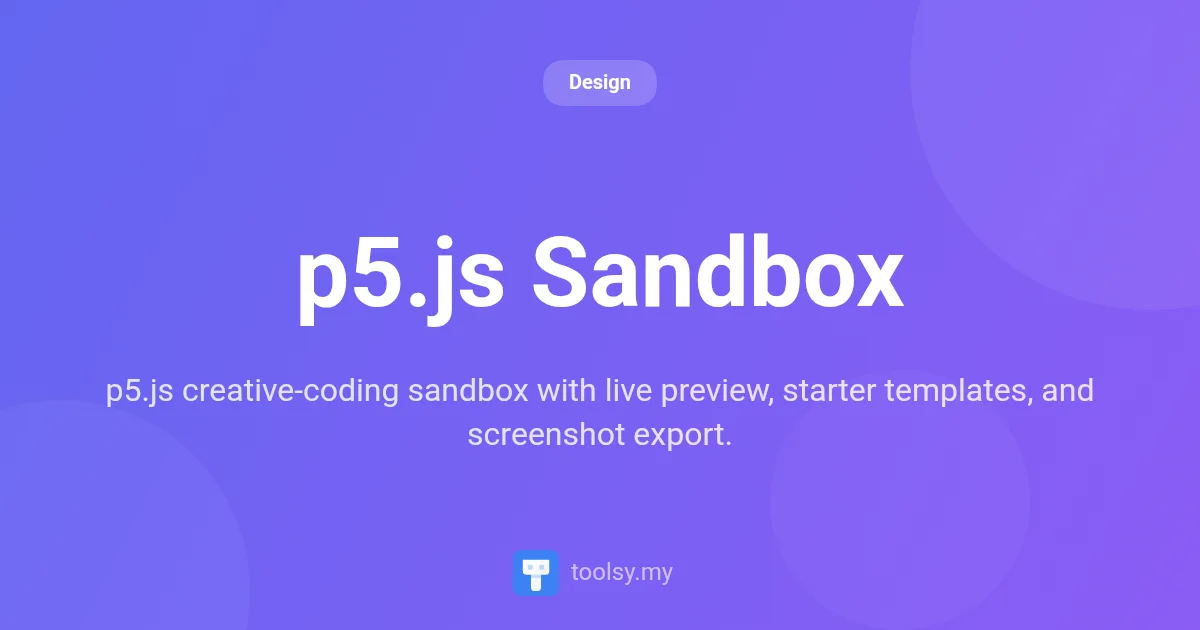
Learn how to use the p5.js Sandbox to write sketches, create generative art, and export HTML. A free, browser-based creative coding playground with templates.
Creative coding has revolutionized how we think about the intersection of art and technology. For years, developers and artists have turned to the p5.js library to bring their visual ideas to life through code. However, setting up a local environment with the right libraries and dependencies can often be a barrier to entry for those who just want to start sketching.
Enter the p5.js Sandbox, a streamlined, browser-based environment designed specifically for rapid creative experimentation. Whether you are a seasoned generative artist or a student writing your first setup() function, this tool provides an instant, zero-configuration workspace to manifest your digital visions. By preloading the p5.js library in a secure, sandboxed iframe, it removes the friction of setup and lets you focus entirely on the logic of your art.
In this guide, we will explore everything the p5.js Sandbox has to offer, from its built-in starter templates to its powerful export features. If you're ready to start coding, you can jump right in at https://toolsy.my/t/p5-playground.
The p5.js Sandbox is an online creative coding playground that allows you to write and execute p5.js sketches with a live, real-time preview. At its core, the tool is built to handle the heavy lifting of environment management. It preloads the p5.js library within a sandboxed iframe, ensuring that your code runs safely and efficiently entirely within your local browser.
The tool is designed around the classic Processing structure: you write your setup() and draw() functions, and the sandbox renders the output instantly. Because it runs locally, there is no latency between writing a line of code and seeing the visual result. It is a comprehensive "Processing online" experience tailored for the modern web developer and digital artist.
The primary advantage of the p5.js Sandbox is its immediacy. Traditional development requires a text editor, a local server, and manual script linking. This sandbox eliminates those steps.
Another significant benefit is the local-first architecture. Since all code execution happens in your browser, your sketches are private and performant. You don't have to worry about server-side lag or losing your work due to connectivity issues while coding. Furthermore, the inclusion of starter templates means you never have to face a blank cursor; you can begin with a complex system like a generative grid or an oscillator and modify it to suit your needs. For those looking to share their work, the ability to download a sketch as a standalone HTML file makes the transition from playground to production seamless.
The p5.js Sandbox is packed with features specifically curated for the creative coding workflow:
<script> tags are required.* Generative Grid: Perfect for exploring patterns and tiling. * Audio-Reactive: Tools for connecting sound to visuals. * Oscillator: Explore mathematical wave functions and periodic movement.
Getting started with your first sketch is simple. Follow these steps to maximize the tool at https://toolsy.my/t/p5-playground:
setup() (for initialization) and draw() (for animation) functions. You can use any standard p5.js functions like ellipse(), rect(), or fill().How can you apply this tool in a real-world context? Here are a few scenarios:
Artists often need to test a specific algorithm—like Perlin noise or recursive branching—before committing it to a larger project. The p5.js Sandbox serves as the perfect "sketchbook" for these technical experiments.
For students learning the basics of programming, the visual feedback of p5.js is invaluable. This sandbox provides a distraction-free environment where beginners can focus on syntax and logic without worrying about file structures.
Using the built-in audio-reactive template, developers can quickly map sound data to visual properties. This is ideal for VJs or web designers looking to create interactive backgrounds that respond to user input or music.
Designers can use the oscillator and grid templates to prototype complex animations or background patterns that will eventually be integrated into a web application.
While you need to be online to load the tool initially at https://toolsy.my/t/p5-playground, the code execution happens locally in your browser's memory. If you download your sketch as an HTML file, that file can be opened and run offline.
No. The sandbox automatically preloads the p5.js library into the execution environment. You only need to write the JavaScript logic for your sketch.
The tool includes several pre-configured templates: Particles, Generative Grid, Audio-Reactive, and Oscillator. These cover the most common foundations for creative coding projects.
You can save your work by using the "Download-as-HTML" feature. This saves your code locally on your computer so you can re-upload or edit it later.
The p5.js Sandbox is more than just an editor; it is a gateway to the world of generative art and creative expression. By removing the technical hurdles of environment setup and providing robust tools like live previews and starter templates, it empowers anyone to become a digital artist. Whether you are building complex particle systems or simple geometric patterns, this sandbox provides the stability and speed you need.
Ready to start your next creative project? Visit the p5.js Sandbox today and turn your code into art.
Found this helpful? Share it
Try it yourself — it's free to use
p5.js creative-coding sandbox with live preview, starter templates, and screenshot export.
Open p5.js Sandbox →